Guide to Reading Real Estate Project Specifications in Dhaka | JCX Developments Ltd.
16777

Guide to Reading Real Estate Project Specifications in Dhaka

Every real estate project begins with one crucial document, the project specifications. Simply put, this is the blueprint that tells you every detail related to the construction method. A detailed spec sheet lists everything from the grade of cement and thickness of steel bars to the type of wiring, plumbing, flooring tiles, and paint; you name it. Two buildings might look identical with completely different specs. One could use standard MS rods, while the other uses high-tensile TMT bars. As a conscious and well-read homeowner, you should know where your money is going. That’s why, today, we’re going to discuss how to read project specifications and spot red flags before they cost you.

Structural Specifications

Structural Specifications Credit The structural specifications are the skeleton of a building. This sheet outlines everything from the perfect orientation for the building to how it will respond to environmental stresses like earthquakes.
Framing

In Bangladesh, most high-rise buildings utilize an RCC frame. A good specification will clearly state the concrete mix ratio, the grade of steel used, and the method of curing. It should look like:
  • Concrete Grade: Common grades include M25 or M30, indicating the compressive strength.
  • Steel Grade: TMT bars are preferred for their strength and ductility.
  • Reinforcement Detailing: Information on bar sizes, spacing, and placement ensures structural integrity.

Foundation Types

The foundation transfers the building's load to the ground. Soil conditions vary in big cities. So, developers use either a pile foundation or a raft foundation.
  • Pile Foundation: Deep foundations that reach stable soil layers, suitable for soft or loose soils.
  • Raft Foundation: A large concrete slab supporting the building, used when the soil bearing capacity is moderate.

Seismic Design Considerations

Given Bangladesh's susceptibility to earthquakes, adherence to seismic design standards is vital. The Bangladesh National Building Code (BNBC 2020) categorizes the country into four seismic zones:
  • Zone I: Low seismic risk (Z=0.12)
  • Zone II: Moderate seismic risk (Z=0.20)
  • Zone III: High seismic risk (Z=0.28)
  • Zone IV: Very high seismic risk (Z=0.36)

Architectural & Finishing Details

Architectural & Finishing Details
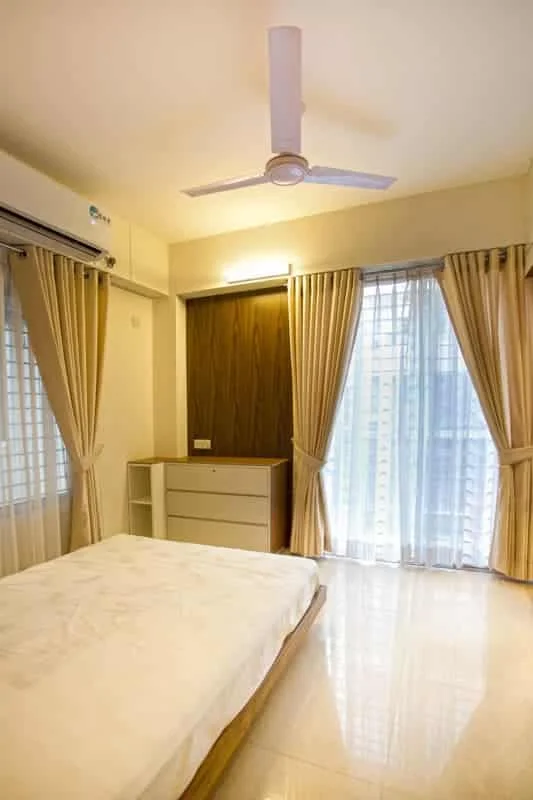
Credit In today’s Bangladeshi architecture, most of the finishing details are about aesthetics. A specification sheet usually lists things like floor materials, wall finishes, paint types, false ceilings, and fixtures. With a close analysis, we can see how modern design and smart material choices come together.

The Floor

Floor finishes are often the first thing that catches the eye. The sheet should mention the type, grade, and installation method. For instance, “vitrified tiles 600×600mm, PEI 4 rating, matte finish” feels more robust than a vague “premium floor tiles.” Standard ceramic tiles can be seen in most apartments because they are affordable and versatile. Now, if you’re trying to elevate the look, you can go for marble or engineered wood. Engineered wood flooring should come with details about the base layer (usually plywood or HDF) and the top veneer thickness. In high-end apartments, a mix of marble and imported tiles is common, but only if the developer specifies the stone type (like Botticino or Carrara) and its country of origin.

The Wall

Next comes wall treatments. Basic emulsion paints are common. But they tend to absorb humidity, which later leads to peeling and/or mold. Your options are:
  • Standard Finishes: Emulsion paints are durable, and you get a wide range of colors.
  • Premium Finishes: Lime plaster provides a breathable surface, reducing moisture buildup and preventing mold growth.
The document should list the plaster type. You know, cement plaster, gypsum, or lime-based, and also the paint brand and category. Look for phrases like “moisture-resistant emulsion” or “washable satin finish.” It will provide durability against Dhaka’s humidity. Bathrooms and kitchens need waterproofing layers beneath the tiles. If the spec skips this, prepare to welcome damp patches within a year. A good sheet will even note primer coats and recommended repaint cycles.

Doors and Windows

Now, check the doors and windows section. Here, you’ll often see words like “UPVC” or “powder-coated aluminum,” but the devil is in the details. The spec should state the frame thickness, hardware brand, and glazing type:
  • Single
  • Double
  • Laminated
In high-rise projects, double-glazed windows aren’t deemed luxurious. They work as a noise and heat barrier. Hinges, locks, handles, etc. should come from recognized brands, with a note on finishing. If you see only “imported fittings,” not be afraid to ask where and which brand.

Electrical & Plumbing Systems

Welcome to the section most homebuyers skip, and later regret. The MEP (Mechanical, Electrical, and Plumbing) systems are the invisible lifelines that keep your home functional. Let’s break this down piece by piece before your “dream apartment” turns into an engineering case study.

Generators & Backup Power

Bangladesh and power outages go together like tea and biscuits. So, the generator is a pretty serious backup. Check which things are covered, just lights and fans, or also elevators and air conditioning, too? A project that lists “generator backup for all essential loads” deserves extra points. Look for mention of an Auto Transfer Switch. It makes sure the generator kicks in immediately during an outage.

Electrical Systems

If the structure is the skeleton, the electrical system is the nerves. Always go for 100% copper wiring, not aluminum alternatives that overheat faster than an inverter. Look for references to IS or IEC standards. These are international safety benchmarks that separate responsible wiring from future shock hazards. Also, check where the DB is placed and the breaker capacities. If you see “16A, 20A, 32A” mentioned next to circuits, that’s a good sign. It means someone actually calculated the load. Earthing should be clearly defined, too. Smart developers now include EV charging points or inverter-ready wiring. Because trust me, rewiring later is as fun as paying property tax twice.

Plumbing

Plumbing is one of those things you never notice until it starts leaking. The spec sheet should list pipe materials like UPVC, CPVC, GI, or HDPE. Each has a role:
  • CPVC is best for hot water
  • HDPE suits underground lines
  • UPVC handles most cold-water distribution
If you can’t find any mention of pipe types, pump capacity, or tank redundancy, assume you’ll be making friends with your plumber soon. Also, note whether the building connects to a sewer line or uses a septic tank. For apartments in Dhaka, a two-pump system (one active, one standby) is typically used for a consistent water supply. This is the kind of redundancy you’ll thank the developer for when your shower doesn’t sputter mid-shampoo. Bonus points if the specs mention isolation valves and access points for maintenance.

Tips & Tricks for Spotting Quality

Don’t rely on model flats. If you want to know what you’re really buying, go see the site yourself. Nothing replaces the insight you get from being on the ground. When you visit, take a printed copy of the specification and a detailed checklist. Ask to see the material delivery notes, and look closely at the brand names and batch numbers. These small details reveal whether the builder is sticking to a standard or cutting corners. Request a look at a mockup tile to check texture, color, and finish consistency. Before any concrete is poured, ask if you can safely view the reinforcement section. You’re not being nosy, you’re being smart with your investment. Don’t stop there. Take a walk to the cement and aggregate stock area. If materials are stored haphazardly, that’s a red flag. Organized sites tend to reflect organized developers. And if the developer seems hesitant to show you materials or claims they’re “not available right now,” treat that as a warning sign. Transparency is a mark of confidence.

Wrapping Up

A good site inspection is part curiosity, part common sense. The more you question, the more you see. Going through project specifications will require you to understand a lot of construction-related jargon. But at the end of the day, it’s all worth it. Because true quality is built on structural integrity and a developer’s honesty in following through. At JCX Developments, we believe transparency is the foundation of trust. Every project we build reflects precision in planning. When you invest in a JCX home, you’re not just buying a property; you’re investing in a process that values accountability as much as aesthetics.

testimonials

People across the globe trust us for Quality Construction & world-class materials selection!

-Yang Huan Huan

I must praise the consultant who worked with us and helped us choose the perfect apartment. He understood our requirements very well and helped us accordingly. Great team!

-Morshed Hossain

Thank you for helping us throughout the project and also getting the apartment ready on time. Really happy with the effort of your team and wish you success.

-Mehazabien Chowdhury

Assalamu Alaikum. I want to start by thanking the people at JCX for being very friendly and understanding. I have experienced this kind of cooperation very rarely in this industry. Best Wishes to the company.

-Mohshin Ahmed

JCX Developments BD has made it very easy for us to find and buy the perfect home as we imagined.

-Dina Akhter

Our Awards and Recognition

awards
awards
awards